
- Doctors
- Patients Care & Health Info
-
Services
- Education & Fellowships
- Myopia Clinic & Lasik Center
- View Prescription
May 2026
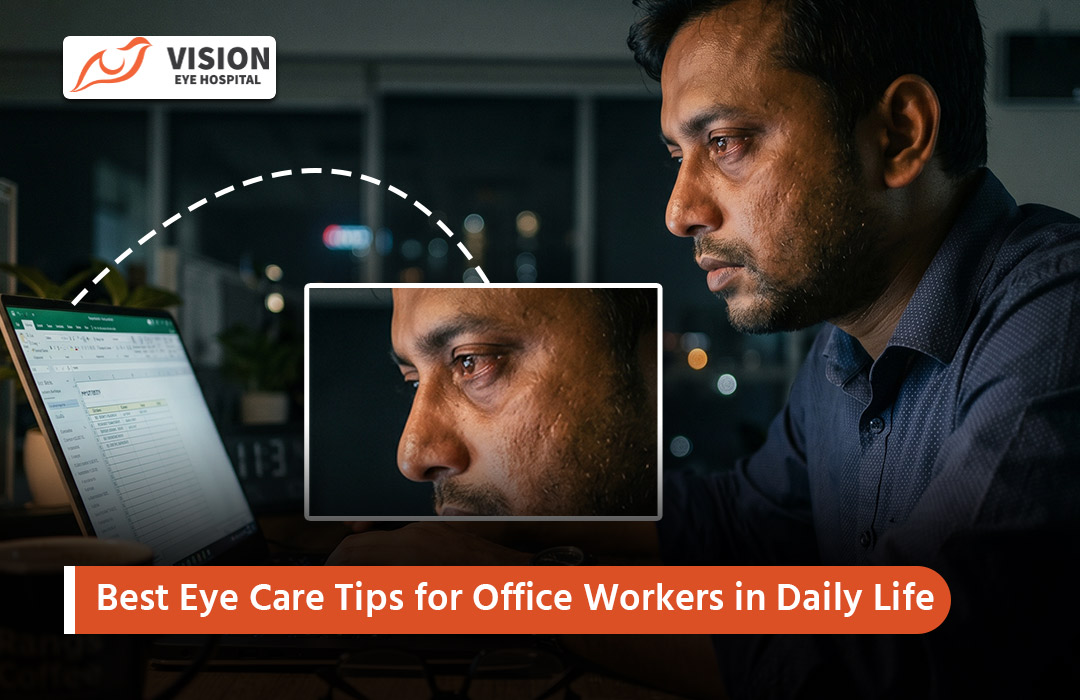
In today's digital world, office workers spend hours staring at computer screens, which can take a toll on eye health. At Vision Eye Hospital in Dhaka, Bangladesh, we see many patients dealing with vision issues from prolonged screen time. Prioritizing eye care helps maintain productivity, prevent discomfort, and protect long-term vision.
Extended screen exposure leads to digital eye strain (also known as Computer Vision Syndrome or CVS). Symptoms include tired eyes, headaches, blurred vision, neck pain, and reduced focus. Without proper care, these issues can worsen into chronic problems like dry eye syndrome or refractive errors. Good eye habits boost comfort, concentration, and overall well-being, helping you stay efficient at work.
Digital eye strain: Eye fatigue, burning, or itching.
Dry eyes: Reduced blinking (from ~15-20 times per minute normally to as low as 5-7 while staring at screens) causes insufficient tear film.
Blurred vision and headaches: From constant focusing on nearby objects.
Neck, shoulder, and back pain: Often due to poor posture while viewing screens.
Increased risk of myopia progression or other refractive issues over time.
Simple adjustments make a big difference:
Take regular breaks.
Optimize your workspace lighting to reduce glare.
Position your screen properly.
Blink consciously and frequently.
Ensure your environment has balanced lighting — avoid working in complete darkness or under harsh overhead lights.
This easy, evidence-based technique is one of the most effective ways to combat eye strain. Every 20 minutes, look at something 20 feet (about 6 meters) away for 20 seconds. This allows your eye muscles to relax and refocus. Set a timer or use apps as reminders. During the break, blink deliberately to moisten your eyes. Many patients report significant relief by following this rule consistently.
Brightness: Match it to your surrounding light (roughly 100-150 cd/m² in typical offices). Avoid screens that are much brighter than the room.
Contrast: Keep it high for easier reading.
Color temperature: Reduce blue light by using warmer tones (night mode or blue light filters) especially in the evening.
Font size and sharpness: Increase text size and ensure anti-aliasing for clarity.
Enable dark mode where possible and use anti-glare screen protectors.
Ergonomics matter greatly:
Keep your monitor at arm's length (20-28 inches or about 50-70 cm away).
Position the top of the screen at or slightly below eye level so you look downward slightly (this helps keep eyes more moist).
Sit with your back straight, feet flat on the floor, and chair providing good lumbar support.
Tilt the screen slightly upward toward your eyes.
Avoid reflections from windows or lights by positioning your monitor perpendicular to them.
Support your eyes from within with these nutrients:
Vitamin A, C, E: Found in carrots, citrus fruits, spinach, and almonds.
Lutein and Zeaxanthin: In leafy greens like spinach, kale, and broccoli.
Omega-3 fatty acids: From fish (salmon), flaxseeds, or walnuts — excellent for dry eyes.
Zinc: In nuts, seeds, and legumes. Stay hydrated throughout the day, as dehydration worsens dry eyes. A balanced diet rich in colorful fruits and vegetables promotes better vision health.
Palming: Rub your palms together to warm them, then cup them gently over closed eyes for 30-60 seconds.
Focus shifting: Alternate focus between a near object and a far one.
Eye rolls and blinks: Slowly roll your eyes in circles and blink rapidly for a few seconds.
Follow the 20-20-20 rule as a built-in exercise.
Perform these during breaks for quick relief.
Blink more often consciously.
Use preservative-free artificial tears (lubricating eye drops) as needed.
Consider a desktop humidifier in air-conditioned offices.
Position yourself away from direct AC vents.
Stay well-hydrated and follow screen best practices.
Consult an eye doctor promptly if you experience:
Persistent blurred vision or headaches.
Severe dryness, redness, or pain.
Difficulty focusing that doesn't improve with breaks.
Any sudden changes in vision.
Regular eye check-ups (at least once a year) are recommended for office workers, especially if you wear glasses or have risk factors. Early detection prevents complications.
By incorporating these tips into your daily routine, you can significantly reduce eye strain and maintain healthy vision for years to come. At Vision Eye Hospital in Dhaka, our experienced ophthalmologists provide comprehensive eye care, from routine check-ups to advanced treatments.
Book your eye examination today and take the first step toward better eye health!





John Doe
10 days agoLorem ipsum dolor, sit amet consectetur adipisicing elit. Perferendis cum illum facere in exercitationem assumenda corporis itaque excepturi molestias voluptas, quibusdam accusantium, quae dolore iste eum aliquam saepe eius iure.
John Doe
10 days agoLorem ipsum dolor, sit amet consectetur adipisicing elit. Perferendis cum illum facere in exercitationem assumenda corporis itaque excepturi molestias voluptas, quibusdam accusantium, quae dolore iste eum aliquam saepe eius iure.