-
Administration
-
28 January, 2026
-
397
Advanced OCT Scan Eye Service in Dhaka
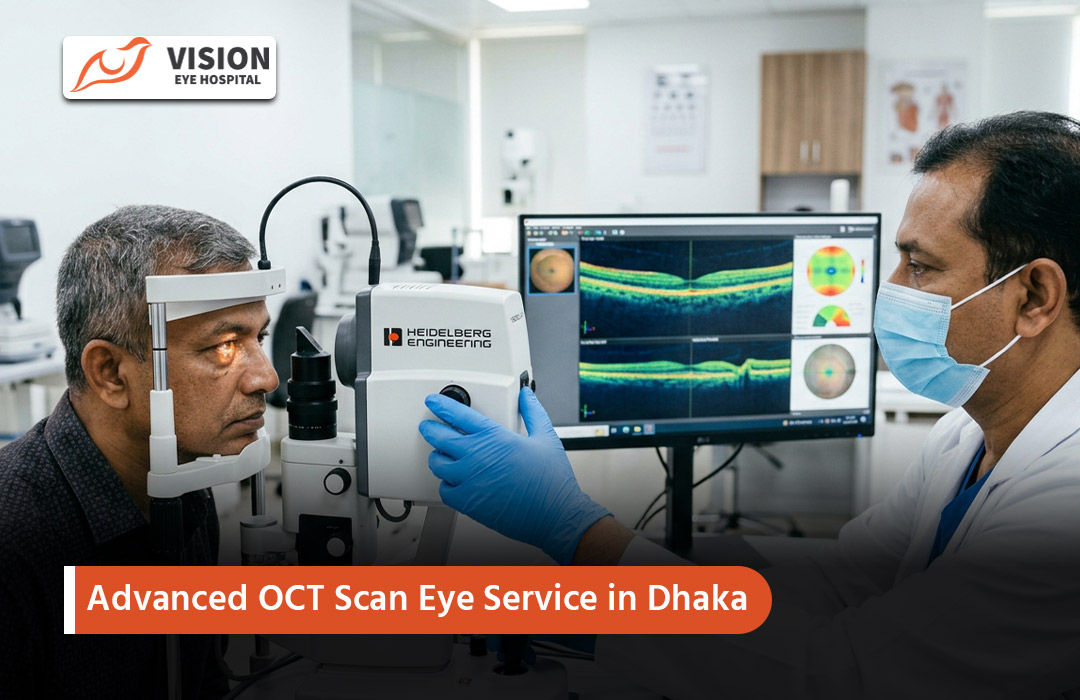
Optical Coherence Tomography (OCT) has revolutionized eye diagnostics by providing detailed, non-invasive imaging of the retina and optic nerve. In Dhaka, advanced OCT services are readily available at top-tier eye hospitals, enabling early detection and precise management of retinal and optic nerve conditions. Facilities like Vision Eye Hospital (equipped with high-resolution systems such as Canon OCT HS100), Bangladesh Eye Hospital, Ispahani Islamia Eye Institute & Hospital, and others offer cutting-edge OCT scans, often combined with OCT-Angiography for enhanced vascular views, supporting comprehensive eye care in Bangladesh.
What Is an OCT Eye Scan?
OCT, or Optical Coherence Tomography, is a high-resolution imaging test that uses near-infrared light waves to capture cross-sectional and 3D images of the retina (the light-sensitive layer at the back of the eye), optic nerve, and sometimes the anterior segment (front structures like the cornea). It produces micron-level detail—similar to an optical biopsy—without touching the eye or using radiation.
Importance of OCT in Eye Health
OCT plays a critical role in modern ophthalmology by detecting subtle changes invisible to standard exams. It enables early intervention for sight-threatening conditions, monitors disease progression, and guides treatment decisions. In Dhaka, where diabetes, hypertension, and aging populations increase retinal risks, OCT helps prevent blindness through timely diagnosis and follow-up.
Conditions Detected by OCT Scan
OCT excels at identifying and monitoring:
-
Diabetic retinopathy and macular edema (swelling in the central retina).
-
Age-related macular degeneration (AMD) — Wet or dry forms.
-
Glaucoma — Optic nerve damage and retinal nerve fiber layer thinning.
-
Macular holes, epiretinal membranes, or vitreomacular traction.
-
Central serous chorioretinopathy, retinal detachments, or cysts.
-
Uveitis, optic neuritis, or other inflammatory issues.
-
Anterior segment conditions via AS-OCT (e.g., corneal thickness, angle assessment).
How OCT Scan Works: Step-by-Step
-
Preparation — You sit comfortably in front of the OCT machine; chin and forehead rest on supports.
-
Fixation — Look at a target light while the technician aligns the device.
-
Scanning — The machine emits low-coherence light waves that reflect off retinal layers; interference patterns create detailed images in seconds.
-
Imaging — Multiple scans (e.g., macular cube, line scans, or radial patterns) produce high-resolution cross-sections or 3D maps.
-
Completion — No dilation needed in many cases (though sometimes used for better views); the entire process takes 5-10 minutes per eye.
It's painless, quick, and safe.
Benefits of Advanced OCT Eye Service
-
High precision — Micron-level resolution for early detection.
-
Non-invasive and fast — No injections or contact; results available immediately.
-
No radiation — Safer than X-rays or CT.
-
Monitoring tool — Tracks changes over time for chronic conditions.
-
Treatment guidance — Informs decisions on injections, laser, or surgery.
-
In Dhaka's advanced centers, features like OCT-Angiography add blood flow mapping without dye.
Who Should Get an OCT Scan
Recommended for:
-
Patients with diabetes (annual screening for retinopathy).
-
Those over 50 or with family history of AMD/glaucoma.
-
Suspected retinal issues (blurred vision, distorted lines, floaters).
-
Glaucoma suspects or diagnosed patients for optic nerve monitoring.
-
Post-surgery follow-up (e.g., after cataract or retinal procedures).
-
Anyone with unexplained vision changes or high-risk factors.
Your ophthalmologist decides based on symptoms and exam.
Preparing for an OCT Eye Examination
-
Bring current glasses/contacts and prescription.
-
Inform about eye drops, medications, or conditions (e.g., allergies).
-
No fasting required; eat normally.
-
If dilation is planned, arrange transport (blurry vision for hours).
-
Remove eye makeup if asked.
-
The test is straightforward—no special prep for most.
Understanding OCT Scan Results
Results show layered retinal images with color-coded thickness maps:
-
Normal — Even layers, healthy optic nerve.
-
Thinning — May indicate glaucoma or atrophy.
-
Fluid/swelling — Cysts or edema in diabetic/macula issues.
-
Disruptions — Holes, detachments, or deposits in AMD. The doctor explains findings, compares to norms/baselines, and discusses next steps (e.g., treatment or repeat scans).
OCT vs Other Eye Diagnostic Tests
|
Test
|
What It Shows
|
Invasiveness
|
Best For
|
OCT Advantage
|
|
Fundus Photography
|
Surface color images of retina
|
Non-invasive
|
Documentation, screening
|
OCT adds cross-sectional depth
|
|
Fluorescein Angiography
|
Blood flow with dye injection
|
Invasive
|
Vascular leaks
|
OCT-Angio often dye-free alternative
|
|
Visual Field Test
|
Peripheral vision mapping
|
Non-invasive
|
Glaucoma progression
|
OCT detects structural changes earlier
|
|
Slit-Lamp Exam
|
Front eye structures
|
Non-invasive
|
Anterior issues
|
OCT provides posterior detail
|
|
B-Scan Ultrasound
|
Internal structures if view obscured
|
Contact
|
Dense cataracts/hemorrhage
|
OCT superior when view clear
|
OCT complements others for a fuller picture.
Choosing the Best OCT Eye Service in Dhaka
Prioritize centers with:
-
Latest OCT machines (e.g., spectral-domain or swept-source for faster, higher-res scans).
-
Experienced retina/glaucoma specialists to interpret results.
-
Comprehensive care (diagnosis to treatment).
-
Positive reviews and accreditation.
Top options in Dhaka include:
-
Vision Eye Hospital — Features advanced diagnostics like Canon OCT HS100, ideal for retina and optic nerve assessments.
-
Bangladesh Eye Hospital — Offers OCT with expert interpretation across branches.
-
Ispahani Islamia Eye Institute & Hospital — Multispecialty referral center with robust imaging for complex cases.
-
Others: Evercare Hospital Dhaka, Hikmah Eye Hospital (with 3D OCT and OCT-Angiography), or Green Life Hospital.
For the best experience, consult a specialist who can recommend based on your needs.
Advanced OCT scans empower early, precise eye care—don't overlook subtle vision changes. If you're in Dhaka and need detailed retinal imaging, book an OCT at a leading center like Vision Eye Hospital today. Clear insights lead to better vision preservation!



John Doe
10 days agoLorem ipsum dolor, sit amet consectetur adipisicing elit. Perferendis cum illum facere in exercitationem assumenda corporis itaque excepturi molestias voluptas, quibusdam accusantium, quae dolore iste eum aliquam saepe eius iure.
John Doe
10 days agoLorem ipsum dolor, sit amet consectetur adipisicing elit. Perferendis cum illum facere in exercitationem assumenda corporis itaque excepturi molestias voluptas, quibusdam accusantium, quae dolore iste eum aliquam saepe eius iure.